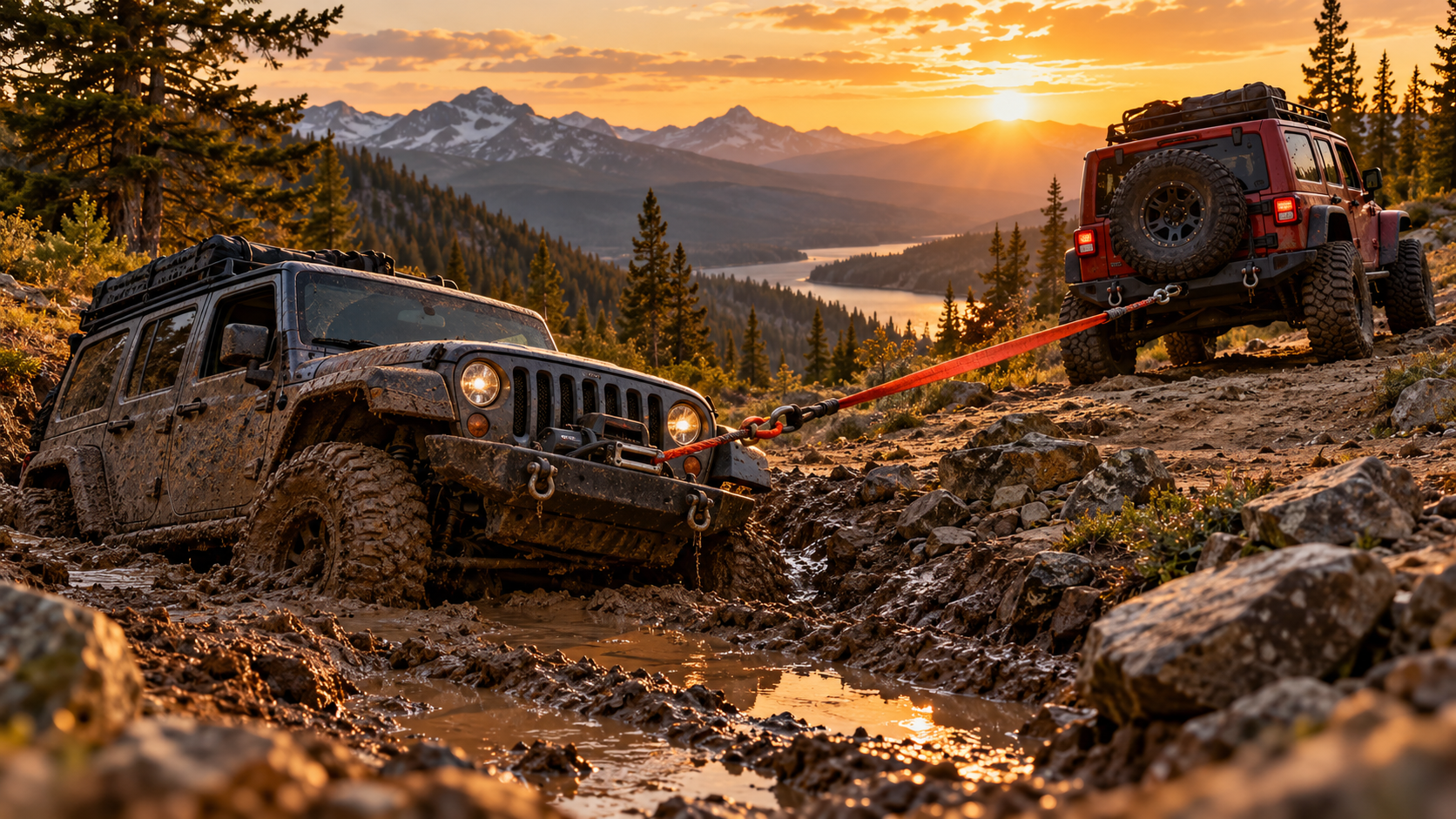
A recovery kit is easy to shop for and surprisingly easy to build badly. There are plenty of preassembled bags filled with straps, shackles, gloves, and assorted hardware, but the number of pieces in the bag tells you very little about whether the kit is actually appropriate for your Jeep.
A useful recovery kit should be built around three things: your vehicle, the terrain you travel, and the equipment already installed on the Jeep.
A stock Wrangler running forest roads does not need the same kit as a lifted Rubicon with a winch tackling technical trails. Likewise, a Jeep that spends most of its time near civilization has different requirements from one traveling hours beyond reliable cell service.
The goal is not to carry everything. It is to carry the right equipment, know what each piece is intended to do, and avoid discovering on the trail that two pieces of your recovery system do not actually work together.
Start With the Jeep, Not the Recovery Bag
Before buying recovery gear, identify the recovery points on your Jeep.
A recovery strap is not particularly useful if you have nowhere appropriate to connect it.
Many Wranglers have useful factory recovery points, while modified Jeeps may have aftermarket bumpers, recovery hooks, or receiver-mounted recovery points. Whatever the configuration, determine which points are intended for vehicle recovery and how your shackles or straps will connect to them.
Do not assume that any substantial-looking piece of metal underneath the Jeep is suitable.
Axles, suspension components, tie-down loops, random frame holes, and trailer balls are not substitutes for proper recovery points.
If your rear recovery solution uses the receiver hitch, consider a purpose-built receiver recovery shackle rather than relying on the trailer ball or ball mount.
This should be sorted out before buying the rest of the kit because your recovery points determine which connectors you need.
The Core Recovery Kit
For most trail-driven Jeeps, a sensible starting point is relatively small:
- Appropriately rated recovery strap or kinetic rope
- Two rated shackles compatible with the Jeep's recovery points
- Heavy recovery gloves
- Compact shovel
- Tire repair kit
- Air compressor
- Accurate tire-pressure gauge
- Flashlight or headlamp
- Jeep-specific basic tool kit
- First-aid kit
- Reliable trail communication
From there, add equipment based on how the Jeep is used.
A winch-equipped Jeep needs additional winching equipment. Frequent sand or mud travel makes traction boards more valuable. Remote travel makes communication, water, and emergency supplies increasingly important.
That approach generally produces a better kit than buying the largest preassembled bag you can find.
Choose the Recovery Strap for the Vehicle
Recovery straps are not all the same.
One of the most useful distinctions to understand when assembling a kit is the difference between a kinetic recovery strap and the straps used for winching.
A kinetic strap or rope is designed to stretch and store energy during a vehicle recovery. A winch extension strap is designed primarily to extend the reach of a winch line. A tree trunk protector is short and wide because it is intended to create a winching anchor around a suitable tree.
They may look similar in a storage bag, but they have different jobs and should not be treated as interchangeable.
There is another detail that is easy to miss when shopping: bigger is not automatically better.
ARB recommends choosing a snatch strap with a minimum breaking strength approximately two to three times the gross vehicle mass of the lighter vehicle involved in the recovery.
That matters because kinetic equipment is intended to stretch. A strap dramatically oversized for the vehicles involved may not behave the way it was designed to.
Also pay attention to the terminology used in product specifications. Working Load Limit, Safe Working Load, and Minimum Breaking Strength describe different things. A large number on a product page is not particularly useful unless you know what that number represents.
Carry Connectors That Match Your Recovery Points
Once you know where you will connect recovery equipment to the Jeep, choose the shackles.
Traditional steel bow or D-shackles remain common because they are strong, compact, and easy to inspect. Look for properly rated recovery shackles rather than generic hardware that simply appears substantial.
ARB recommends using load-rated shackles that display their Working Load Limit or Safe Working Load.
Soft shackles are another useful option. They are light, take up very little room, and eliminate a heavy piece of metal from the recovery system.
They are not automatically appropriate everywhere, however.
Synthetic shackles need smooth attachment surfaces and should be protected from sharp edges and abrasion. If the Jeep's recovery point has a rough or narrow surface, a traditional rated shackle may be the better connector.
For many Jeeps, carrying both types provides useful flexibility.
If You Have a Winch, Build a Winch Kit
A winch changes what belongs in the recovery bag.
The winch itself is only one part of a useful winching system. A winch-equipped Jeep should generally have supporting equipment such as:
- Rated shackles
- Heavy gloves
- Tree trunk protector
- Compatible winch pulley or snatch block
- Winch extension strap
- Recovery damper when appropriate to the equipment
A tree trunk protector belongs in the kit even if you do not frequently expect to winch from trees. It provides a proper wide anchor strap rather than putting the winch line itself around a trunk.
A pulley or snatch block also provides more than simply additional pulling capacity. It gives the winch system more rigging options when the available anchor is not directly in line with the Jeep.
There is an important compatibility issue for Jeeps running synthetic winch rope.
ARB cautions against using synthetic rope through a snatch block that has previously been used with steel cable. Steel cable can leave burrs or surface damage that may abrade synthetic rope.
If you convert a winch from steel cable to synthetic line, inspect the rest of the winching equipment as part of the conversion rather than assuming every accessory should automatically carry over.
Tire Repair and Air Belong in the Recovery Kit
For many Jeep owners, the tire equipment may get used more often than the recovery strap.
At minimum, consider carrying:
- Quality tire plug kit
- Reliable portable or onboard compressor
- Accurate pressure gauge
- Usable spare tire
- Tools necessary to change that tire
A tire plug kit without a compressor is only half a solution.
Likewise, airing down on the trail becomes much more practical when you know you have a reliable way to air the tires back up before returning to pavement.
A compressor also makes it possible to deal with a slow leak or repaired puncture without immediately consuming the spare.
Do not simply buy a plug kit and throw it unopened under the seat. Make sure you know what tools are in it, confirm that nothing important is missing, and understand how the kit is intended to be used.
Traction Boards and a Shovel Fill a Different Role
Not every recovery problem requires another vehicle or a winch.
Traction boards can provide a surface for a tire that has lost traction in sand, snow, or mud. They can also be useful for filling small terrain gaps or helping a tire climb out of a hole.
They are bulky, however, so whether they deserve permanent space on the Jeep depends heavily on where you travel.
A shovel is easier to justify.
A compact shovel can clear dirt, mud, sand, or snow from around a tire or axle, remove material beneath a high-centered vehicle, prepare a location for traction boards, or create a more stable area for a jack.
It is inexpensive, simple, and useful in a wide range of situations.
If cargo space is limited, the shovel is one of the last pieces of basic recovery equipment I would remove.
Think Carefully Before Adding an Off-Road Jack
A tall mechanical off-road jack is one of the most recognizable accessories mounted to trail Jeeps.
That does not mean every Jeep needs one.
Before adding one to the recovery kit, first determine where it can actually lift your particular Jeep.
A stock plastic bumper may offer no suitable lifting location. Some aftermarket bumpers and rock rails do. Vehicle modifications, tire size, and suspension height can also affect whether the jack is useful.
If the Jeep does not have appropriate lifting points, carrying a tall jack may add weight and complexity without adding much real capability.
A base plate is also worth considering if the jack will be used on mud, sand, or other soft terrain.
Buy the jack because it solves a specific problem on your Jeep, not because recovery-equipped Jeeps are expected to have one mounted to the hood.
Build a Small Tool Kit Specifically for Your Jeep
A trail tool kit should reflect the vehicle it rides in.
A giant generic mechanics kit may contain hundreds of pieces while still missing the one Torx bit or socket you actually need.
Wranglers use numerous Torx fasteners, so identify the sizes relevant to your Jeep and make sure they are in the bag.
A useful basic kit may include:
- Common sockets and wrenches used on the Jeep
- Appropriate Torx bits
- Screwdrivers
- Pliers
- Side cutters
- Electrical tape
- Quality duct tape
- Heavy zip ties
- Spare fuses
- Basic multimeter
- Small assortment of useful fasteners
Think of this as a get-home kit rather than a mobile repair shop.
The objective is to handle the kinds of minor failures that might otherwise leave an operable Jeep stranded on the trail.
Communication Belongs in the Kit
Recovery equipment cannot solve every problem.
Cellular service also tends to become unreliable in exactly the places where a recovery problem becomes more serious.
For trail groups, carrying whatever radio system the group uses is a practical part of the recovery kit. GMRS has become common among recreational four-wheel-drive groups and can provide vehicle-to-vehicle communication when terrain separates the convoy.
For genuinely remote travel, consider whether satellite communication belongs in the kit as well.
The farther you travel from other people, pavement, and cellular coverage, the more important communication becomes.
A strap may get the Jeep unstuck. It cannot summon help for a mechanical failure, injury, or vehicle that simply cannot be recovered with the equipment available.
ARB Provides a Useful Baseline
ARB is one of the best-known names in off-road recovery equipment, and its own recovery guidance provides a useful baseline for what belongs in a properly assembled trail kit.
Its recovery kits combine the same core components that repeatedly show up in well-equipped trail vehicles: rated straps, shackles, gloves, tree trunk protectors, and, in more complete kits, winching equipment such as snatch blocks, winch extensions, and recovery dampers.
That does not mean an ARB kit is the only way to build a recovery setup.
What makes ARB useful as a reference is the way its kits scale with the amount of equipment needed.
The ARB Weekender Recovery Kit provides the basic strap, shackle, and glove foundation.
The ARB Essentials Recovery Kit adds a tree trunk protector and snatch block, making it more appropriate for a Jeep equipped for winching.
The ARB Premium Recovery Kit expands the system further with additional winching equipment, including a winch extension strap and recovery damper.
For someone starting from nothing, those kits provide a useful example of how a recovery setup can grow from basic vehicle-to-vehicle equipment into a more complete winching system.
You can buy the complete kit or use the same structure to assemble one piece by piece.
Build the Kit in Layers
For most Jeep owners, it makes sense to build the recovery kit progressively rather than buy everything at once.
Basic Trail Kit
Start with:
- Known front and rear recovery points
- Appropriately sized recovery strap or kinetic rope
- Rated shackles
- Recovery gloves
- Shovel
- Tire plug kit
- Compressor
- Tire-pressure gauge
- Flashlight
- Basic Jeep tool kit
- First-aid kit
- Trail communication
That covers a surprisingly large percentage of realistic trail problems.
Winch-Equipped Jeep
Add:
- Tree trunk protector
- Compatible pulley or snatch block
- Winch extension strap
- Appropriate recovery damper
- Additional rated connectors
The exact contents should match the winch line and recovery points already installed on the Jeep.
Remote or More Technical Travel
Consider adding:
- Traction boards
- Additional tire repair supplies
- More comprehensive tools
- Spare vehicle-specific parts
- Satellite communication
- Additional water
- Weather protection
- Emergency supplies appropriate to the environment
The farther you travel from assistance, the more the kit begins to overlap with general trail preparedness.
Do Not Forget the Bag Itself
Recovery equipment is dirty.
Straps get muddy. Shackles collect grit. Gloves get wet. Tire repair tools end up covered in rubber cement and road grime.
Use a recovery bag that keeps this equipment together and allows you to find it quickly without unloading half the Jeep.
Keeping recovery gear separate from general tools also makes periodic inspection easier.
Straps and synthetic rope should be checked for cuts, abrasion, contamination, heat damage, and damaged stitching. Shackles and recovery points should be inspected for deformation, corrosion, and other damage.
ARB recommends cleaning dirty recovery straps with warm water and mild detergent and allowing them to dry thoroughly before storage.
Do not put wet synthetic recovery gear into a sealed bag and forget about it until the next trip.
Build the Kit You Will Actually Carry
It is easy to keep adding equipment until the recovery kit becomes an entire cargo system.
Resist that temptation.
A mostly stock Wrangler traveling maintained forest roads has a different recovery profile from a heavily modified Jeep crawling difficult rock trails.
The right kit is not the one with the most pieces.
It is the one that covers the realistic problems associated with your Jeep and the places you take it.
Start with proper recovery points, rated recovery gear, tire repair and air, basic tools, and communication. Add winching equipment if you have a winch. Add traction and more extensive emergency equipment as your trips become more difficult or remote.
And whenever you add a new piece of equipment, make sure you understand why it is in the bag and that it works with everything already there.
That is the difference between owning a bag of recovery gear and having a recovery kit.
Jeep Field Guide may earn a commission from qualifying purchases when affiliate links are present. Recommendations are selected editorially, not because a merchant pays for placement.