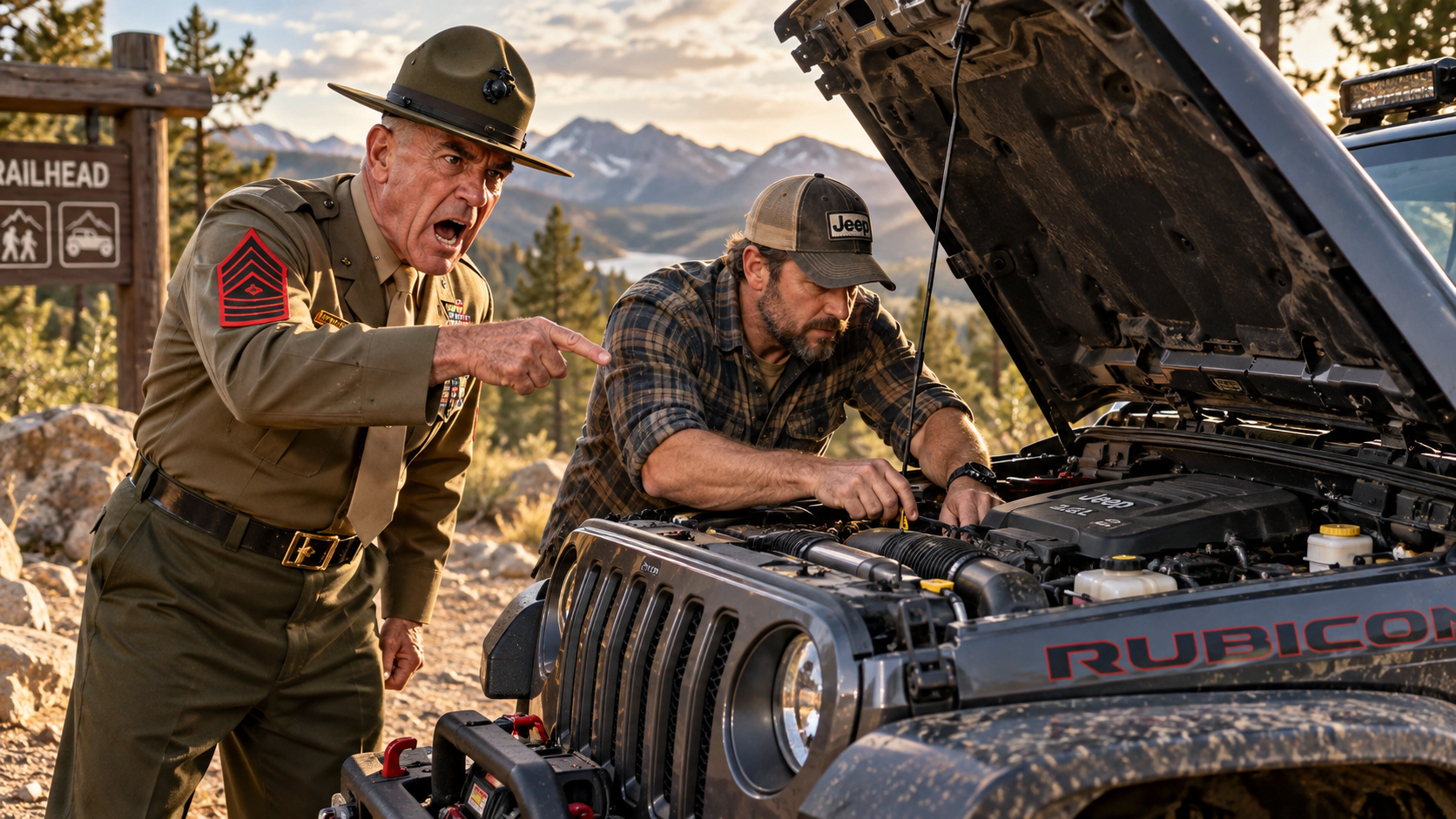
During my time in the military, just about every convoy or mission began the same way: with PMCS, Preventive Maintenance Checks and Services. Before a vehicle left the motor pool, someone walked around it, looked underneath it, checked the things that mattered, and made sure obvious problems were caught before they became problems somewhere less convenient.
A weekend Jeep trip does not require a military inspection process, a maintenance manual, or an hour with the hood open. But the basic idea still holds up remarkably well.
You do not need a lift, diagnostic scan, or elaborate checklist before every weekend away. You need five quiet minutes before loading the last cooler and leaving the driveway.
The goal is simple: catch the easy things while you are still standing next to your garage.
Walk Around the Jeep
Start with one slow lap around the vehicle.
Look at all four road tires and the spare. Check pressures cold when practical, and pay attention to anything that looks different from the last time you drove it. A tire that is noticeably lower than the others deserves an explanation before you head out.
Look at the tread and sidewalls, especially if the Jeep has recently been off-road. Cuts, missing chunks, embedded objects, or sidewall damage are much easier to deal with in the driveway than halfway down a trail.
Take a quick look at the lug nuts as well, particularly after a tire rotation, wheel change, or recent service.
Then look underneath.
Fresh fluid on the driveway is worth investigating. So are wet areas around the axles, differential covers, transmission, transfer case, shocks, or engine.
You are not trying to diagnose every possible problem. You are looking for something that has changed.
That was one of the useful ideas behind PMCS in the military. Familiarity with a vehicle makes abnormalities easier to spot. A leak, hanging wire, loose shield, or damaged component stands out quickly when you know what the Jeep normally looks like.
Scan the wheel wells and underbody for anything obviously out of place, including loose plastic, damaged wiring, bent brackets, branches, or trail debris.
Open the Hood
Pop the hood and spend another minute looking around.
Check the fluid levels that are appropriate for owner inspection on your particular Jeep. Depending on model and powertrain, that may include engine oil, coolant reservoir level, brake fluid, and windshield washer fluid.
Do not open a pressurized cooling system when the engine is hot.
Look for fresh leaks, loose caps, damaged hoses, unusual residue, or anything else that appears different from the last time you were under the hood.
Take a quick look at the battery, too. Make sure the terminals are secure and that there is no obvious corrosion or loose hardware.
The goal is not to perform maintenance before every trip. It is simply to catch obvious problems before they follow you away from home.
Check the Things You Will Actually Rely On
Turn on the exterior lights.
Check the headlights, brake lights, turn signals, and any auxiliary lighting you expect to use. Test the wipers and washer system, especially if the forecast includes rain, snow, dust, or mud.
Then check the gear you expect to rely on once you leave pavement.
If your phone handles navigation, confirm that the charging cable works. If you carry a GMRS radio, GPS unit, satellite communicator, or other communication equipment, make sure it powers on.
Do the same for portable equipment such as:
- Air compressor
- Jump pack
- Flashlight or headlamp
- Handheld radio
- Satellite communicator
- Portable power station
- Battery-powered tire inflator
A dead jump pack or uncharged compressor is not emergency equipment. It is cargo.
This is one area where the civilian version is easier than military PMCS. There is no form to sign and nobody checking your work. You simply need to verify that the equipment you are counting on will actually work when you need it.
Do Not Forget the Spare
The spare tire is easy to ignore because it is not doing anything.
That changes quickly when you need it.
Check its pressure periodically and before longer trips. A spare hanging on the tailgate can lose a surprising amount of pressure over time without anyone noticing.
Make sure you also have the equipment required to install it.
Confirm that the jack is present, the lug wrench or socket fits your wheels, and any wheel-lock key is actually in the Jeep.
This is especially important on modified vehicles. Larger tires, different wheels, and suspension lifts can make factory equipment less useful than it was when the Jeep left the assembly line.
If the factory jack no longer works well with your setup, find that out at home.
Secure the Interior
A trail turns ordinary cargo into moving cargo.
A toolbox sitting harmlessly behind the rear seat on pavement can become a very different object during a sudden stop, steep climb, or off-camber obstacle.
Secure tools, water bottles, recovery equipment, coolers, compressors, fire extinguishers, and anything else heavy enough to hurt someone if it moves unexpectedly.
Pay particular attention to dense items such as shackles, jacks, and hand tools.
Recovery gear does not do much good if the first rough section of trail scatters it throughout the cargo area.
If you regularly carry the same equipment, give it a consistent location. Besides keeping the Jeep organized, that makes it much easier to notice when something is missing.
Match the Kit to the Trip
The final check is less about the Jeep itself and more about where you are taking it.
A highway road trip, maintained forest road, day at an off-road park, and remote backcountry trail all require different margins.
Think through:
- Fuel
- Drinking water
- Weather
- Clothing
- Tire repair
- Recovery equipment
- Basic tools
- First aid
- Communication
- Navigation
- Distance to fuel or assistance
You do not need to pack for every theoretical disaster.
Pack for the realistic problems associated with the trip you are actually taking, then add a reasonable margin.
Fuel is a good example. A trail that looks short on a map can consume considerably more fuel than the same mileage on pavement. Low-range driving, obstacles, idling, detours, and backtracking all add up.
Weather deserves the same consideration. Conditions at the trailhead may have little resemblance to conditions several thousand feet higher or several hours later.
Pay Extra Attention to What Changed
One of the most useful pre-trip questions is also one of the simplest:
What changed since the last time I drove this Jeep?
Did you recently rotate the tires?
Install new suspension components?
Change wheels?
Add a winch?
Have work performed at a shop?
Hit something hard on the last trail?
Notice a new sound or vibration?
Anything recently changed deserves more attention than a component that has been quietly doing its job for years.
After modifications or repairs, check nearby fasteners, wiring, hoses, and anything else that might loosen, rub, or settle during the first few trips.
This is another idea that carries over well from PMCS. You are not trying to prove that every component is perfect. You are trying to notice changes before they become failures.
Five Minutes Is Usually Enough
A pre-trip check should not become such an elaborate ritual that you stop doing it.
For a regularly maintained Jeep, five focused minutes can cover a lot.
Walk around the vehicle. Look at the tires. Look underneath. Open the hood. Check the equipment you plan to rely on. Secure the cargo. Make sure the trip kit fits the destination.
If something catches your attention, then slow down and investigate it.
The point is not anxiety, and it is not pretending every weekend Jeep trip is a military convoy.
It is simply applying a lesson that has worked around vehicles for a very long time: problems are usually easier to solve before you leave.
A loose battery terminal in the driveway is a five-minute inconvenience. A dead Jeep at the end of a remote trail is an entirely different afternoon.
Jeep Field Guide may earn a commission from qualifying purchases when affiliate links are present. Recommendations are selected editorially, not because a merchant pays for placement.